
Advanced AI Video Editing: Regaining Creative Control in Agency Workflows
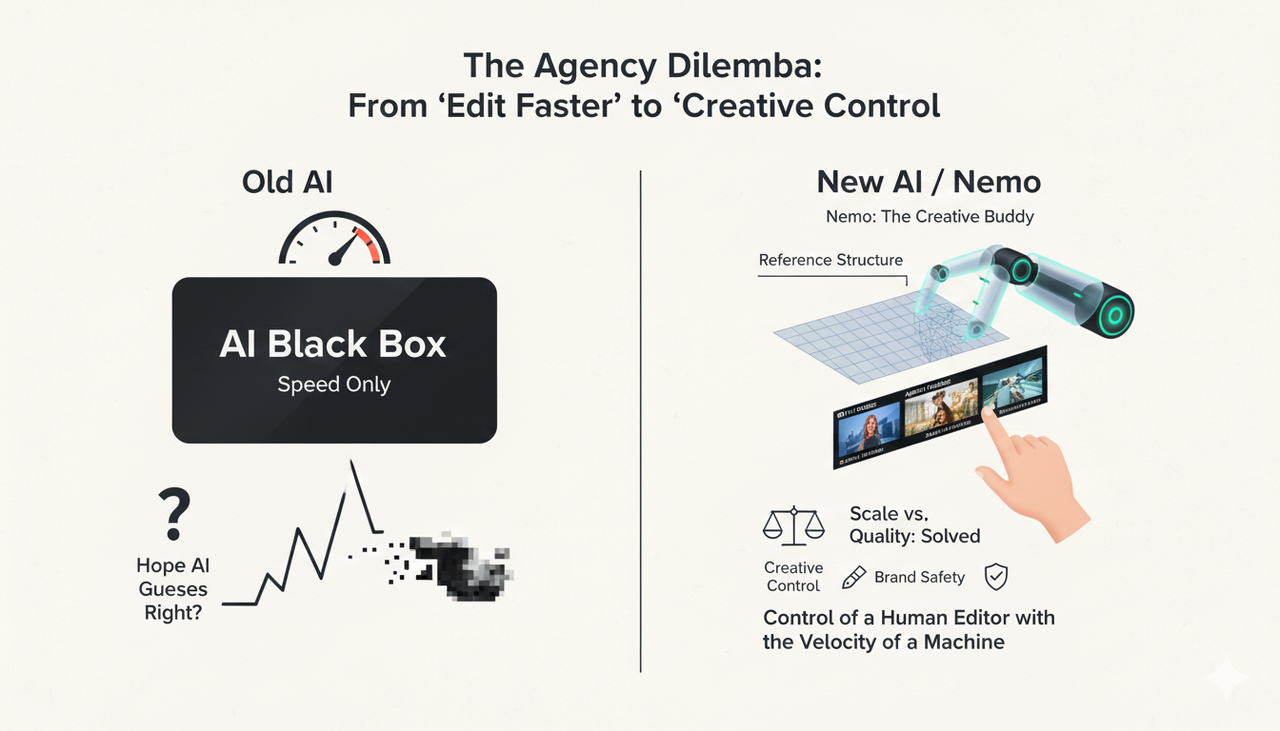
For agencies, the promise of AI has always been speed, but the trade-off has often been a loss of precision. The modern query isn't just "how do I edit faster?" It is "how do I find an AI video editor with more creative control?"
Advanced AI video editing is no longer just about removing silence; it is about steering the AI to replicate complex viral structures while maintaining brand safety. Tools like NemoVideo (AI Video Editor) are leading this shift by acting as a "Creative Buddy" rather than a black box.
Instead of hoping the AI guesses right, you provide the reference, and the AI maps your footage to that proven structure. This gives you control of a human editor with the velocity of a machine, solving the agency dilemma of "Scale vs. Quality."
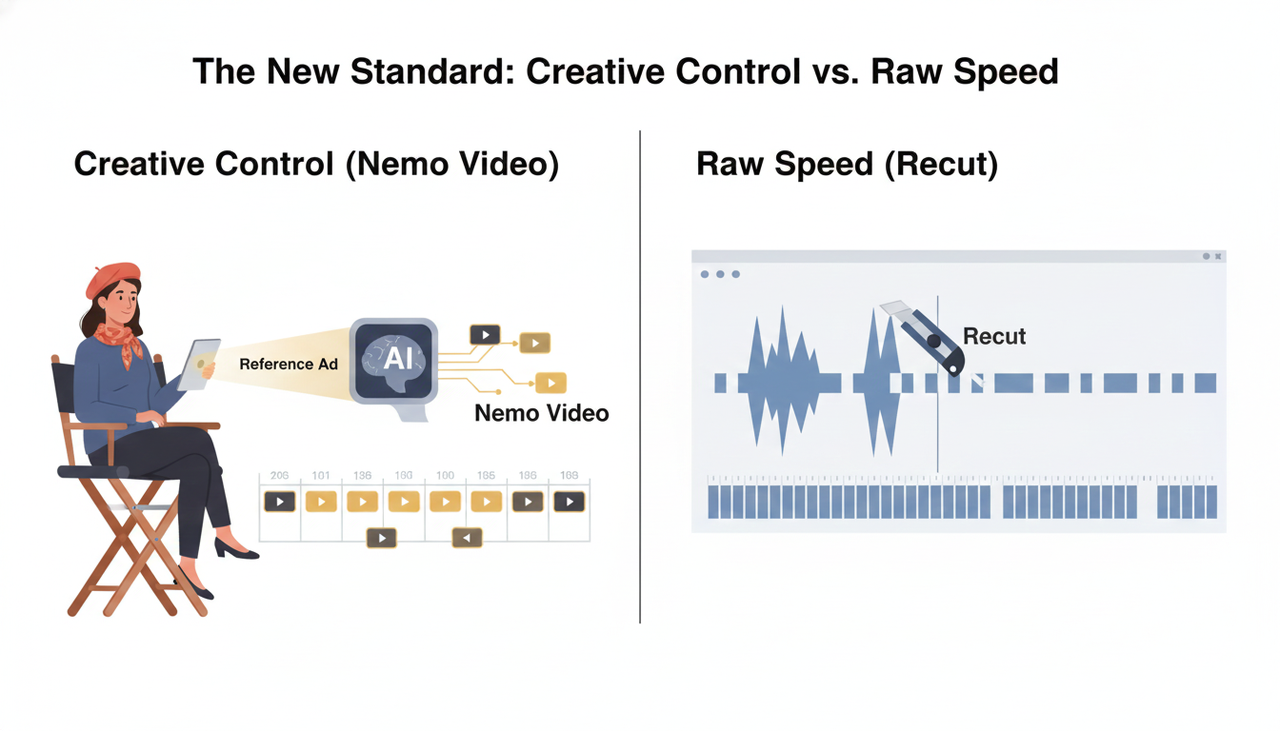
The New Standard: Creative Control vs. Raw Speed
In the landscape of AI video editing solutions, different tools serve different masters. To understand where you gain the most leverage, we must compare two dominant approaches: the structural replication engine (Nemo Video) and the rough-cut accelerator (Recut).
Structural Replication: The "Director" Approach
When you need to turn raw footage into a high-performing ad, you aren't just trimming fat; you are building a narrative.
The Old Way: You manually mark in-points, out-points, and drag transitions to match a reference video on a second monitor.
The Advanced AI Way (Scenario):
You Command: "Analyze this viral TikTok ad. Replicate its pacing and hook structure using my product footage."
The Result: Nemo (AI Video Editor) deconstructs the reference's beat sheet and instantly assembles your raw clips to match that successful pattern, retaining the "soul" of the edit without the manual labor.
This is creative filmmaking at scale. You control vision (the reference), and the AI handles execution.
The Rough-Cut Accelerator: The "Assistant" Approach
Sometimes, you just need to clean the slate. Recut specializes in the "invisible" work—removing silence and tightening dialogue.
The Old Way: You stare at a waveform, hitting "K" and "L" keys for hours to cut out breaths and pauses.
The Scenario:
You Command: "Remove all silence longer than 0.5 seconds."
The Result: The tool scans the audio file and instantly ripples deletes every gap, handing you a condensed XML timeline ready for polish.
While Recut offers speed, it doesn't offer the next-gen video editing capabilities required for A/B testing creative concepts. It is a utility, whereas Nemo Video is a creative engine.
Agency Workflow: From Bulk Versioning to Compliance
The true future of editing isn't just about the cut; it's about the entire pipeline. Once your advanced AI video editing tool has generated the creatives, you must ensure they survive the rigorous ad auction environment.
Step 1: Bulk Versioning & A/B Testing
Agencies live and die by split test best practices. You cannot rely on a single creative person.
Workflow: Use Nemo Video to generate 20 variants of your winning hook.
Why: Video is the top-performing content type online, but only if you test aggressively.
Step 2: Ensuring Ad Compliance
Even the best edit fails if it violates policy. Next-gen video editing workflows must integrate compliance checks early.
Legal: Before you scale, review the FTC Endorsement Guides: What People are Asking. Ensure your AI-generated captions or testimonials meet disclosure standards.
Music: Never use unauthorized audio. Utilize a Commercial Music Library to ensure your viral hit doesn't get muted.
Step 3: Distribution & Accessibility
Finally, your content needs to reach the user.
Accessibility: Use AI to auto-generate captions, ensuring Accessibility for watching videos.
Ad Formats: Whether you are running TikTok Auction In‑Feed Ads or simply Promoting a brand, product, or service, the edit must fit the native format.
Optimization: Follow Creative best practices (like "sound-on" cues) which can be programmed into your AI editing parameters.
AI agency workflow: Versioning, compliance, distribution, and optimization
Comparison: Nemo Video vs. Recut
Feature | Nemo Video | Recut |
Primary Goal | Advanced AI video editing (Structure & Viral Replication) | Speed (Silence Removal) |
Creative Control | High: You dictate the style and structure via references. | Low: Binary control (Silence = Delete). |
Bulk Versioning | Native: Generates multiple hooks/variants for A/B testing. | Manual: Requires XML handoff to NLE for versioning. |
Best For | Agencies needing creative variations & ad performance. | Editors needing to clean up podcasts/interviews fast. |
Ad Ecosystem | Integrates with Commercial Music Library logic. | Agnostic (Pure file processing). |
FAQ: Advanced AI Video Editing
Q: How does advanced AI video editing differ from standard filters?
A: Standard filters apply a "look" (color/overlay). Advanced AI video editing understands the semantics of your video—it. It knows when a speaker is talking, recognizes the climax of a song, and edits the footage to match the beat, offering you superior creative control.
Q: Can I use AI tools for high-end agency work?
A: Yes. The future of editing is hybrid. Agencies use tools like Nemo (AI Video Editor) to handle the bulk "lifting" (versioning, rough cuts, structural matching) and then use human editors for the final 5% of polish.
Q: What are the risks of AI editing?
A: The main risks are copyright and compliance. Always cross-reference your output with FTC Endorsement Guides: What People are Asking and ensure you are following platform-specific rules like Split test best practices.
Q: Which tool is better for TikTok Auction In‑Feed Ads?
A: Nemo Video is superior here because it is designed to replicate the "viral structure" native to feeds, whereas Recut is platform-agnostic and focused purely on dialogue pacing.