

Script Analysis AI: Stop Guessing, Start Scoring Your Next Hit Video
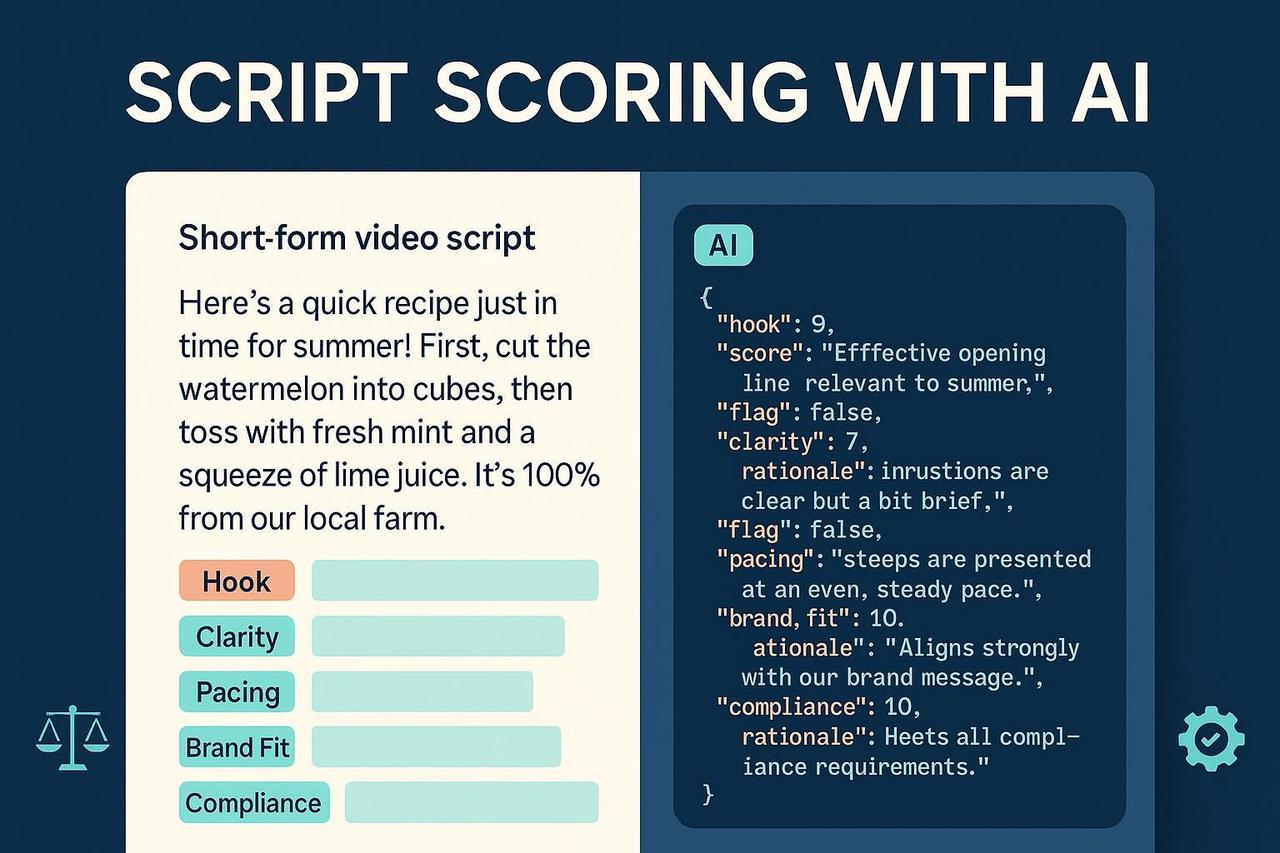
You spend hours crafting the perfect ad script, only to have production flag it for brand misalignment, or worse, it launches and completely bombs. Why? Because manual script analysis is slow, subjective, and prone to human bias. You need a fast, objective pre-flight check for every draft.
As your AI Creative Buddy, I’m here to show you how to use artificially intelligent script analysis to score your drafts before they ever hit the set. This isn't just about efficiency; it's about confidence. We'll show you how to build a reliable AI "judge" to tell you exactly where your script will succeed or fail.
What is AI in Script Analysis? Building Your Judge
What is AI in script analysis? It means using Large Language Models (LLMs) to automatically apply a strict rubric to your script, scoring it on metrics that directly impact performance, like hook strength, pacing, and brand fit. Think of it as an impartial, lightning-fast script supervisor.
You can absolutely get AI to read a script and provide structured feedback. The key is giving the AI a clear role, a perfect rubric, and demanding structured output. This methodology, often called "LLM-as-a-Judge," is covered in depth by experts like Evidently AI in their guide on LLM-as-a-Judge.
The 5-Point Creative Rubric
To start your script analysis ai free model, create a rubric that defines success for short-form content.
Criterion | Score Anchor (5 = Perfect) | Why It Matters |
Hook Strength | Specific value/curiosity gap in the first 0–3 seconds. | Determines your "thumb-stop" rate and initial delivery. |
Clarity | Concise, concrete, single takeaway message. | Ensures the audience knows exactly what to do/think. |
Pacing | Tight beats and smooth transitions that maintain attention. | Fights viewer fatigue and drop-off moments. |
Brand Fit | On-tone, on-value, consistent with brand guidelines. | Reduces the risk of revisions from the marketing team. |
Compliance/Safety | Policy-safe, transparent wording, no risky claims. | Protects your budget and adherence to Meta Advertising Standards. |
Real-World Example: For a fitness app, an AI judge scored "Hook Strength" a 5 because the script began: "Stop scrolling. I’ll show you the 1 stretch that fixes desk-shoulder pain in 10 seconds." It scored a 4 on "Pacing" because the rationale suggested adding a transition cue. This immediate, actionable feedback is how script analysis ai online transforms your workflow.
How to Use AI to Review Your Screenplay (The Tech Steps)
Can AI review my screenplay? Yes. By training an LLM with your rubric, you essentially create a custom, automated reviewer.
Step 1: The Strict Judge Prompt
You need to give the AI a persona and strict rules. The most important rule? Return only JSON. No prose, no fluff, just structured data you can use.
Role: "You are an impartial, strict script-scoring judge. Apply the rubric exactly."
Input: The script text, plus metadata (product, platform, intended tone).
Few-Shot Examples: Provide 2-3 examples of scripts you know are good (score 5) and 2-3 that are poor (score 1), along with the rationale. This improves consistency, a key principle of evaluation discussed by Langfuse in their guide on LLM Evaluation 101.
JSON Schema: Enforce a fixed structure with integer scores (1-5), rationales for each score, and boolean flags (e.g., risky_claims: true).
Step 2: Calibration is King
Your AI judge is useless if it doesn't agree with your human team. This is called calibration.
Gold Set: Select 30-100 past scripts. Have 2-3 experienced human reviewers score them independently using your new rubric.
Run the AI: Feed the same "gold set" to your AI judge.
Compute Agreement: Measure how often the AI scores match the human scores using a metric like Cohen's Kappa (kappa (κ)). You should target kappa (κ) ≥ 0.6 before trusting the scores. If your score is low (kappa (κ) < 0.4$), your rubric anchors or examples need to be clearer.
Legal Example: To address compliance risks, use an ensemble approach. For toxicity, you could pre-check the script using a service like Google's Perspective API before sending it to your main judge. This creates strong safety guardrails, a key practice emphasized in AWS guidance on evaluating generative systems.
Creative Empowerment: Iterating with Scored Scripts
The real magic of artificially intelligent script analysis happens after you get the score. Your AI judge gives you a pass/fail gate and clear instructions on how to fix a failing script.
The Production Workflow
Score & Gate: Approve a script for production only if the overall score is 4 or higher and the "Compliance" score is 4 or higher, with no risk flags set.
Variant Generation: If your script scores high on "Clarity" but low on "Hook Strength," you don't need to rewrite the core message. You only need to generate 5 new hooks (Problem, Contrarian, ASMR, etc.).
Batch Editing: After selecting the top-scoring scripts, you move into bulk versioning. Tools like the NemoVideo AI Video Editor Tool can take your winning script and automatically cut multiple aspect ratios (9:16, 1:1, 16:9) and refine the pacing precisely as requested by the judge's rationale.
Stop wasting time debating subjective scores. Use your script analysis ai free judge to get actionable, data-driven instructions, and use NemoVideo to execute those instructions at the speed of AI.
Start scoring your scripts and generating winning video variants with NemoVideo today!