

Editing Psychology: Master the Cognitive Triggers That Keep Viewers Watching
Why do some videos make you lean in, while others make you scroll away in seconds?
It’s not just about the camera or the script. It’s about the cut.
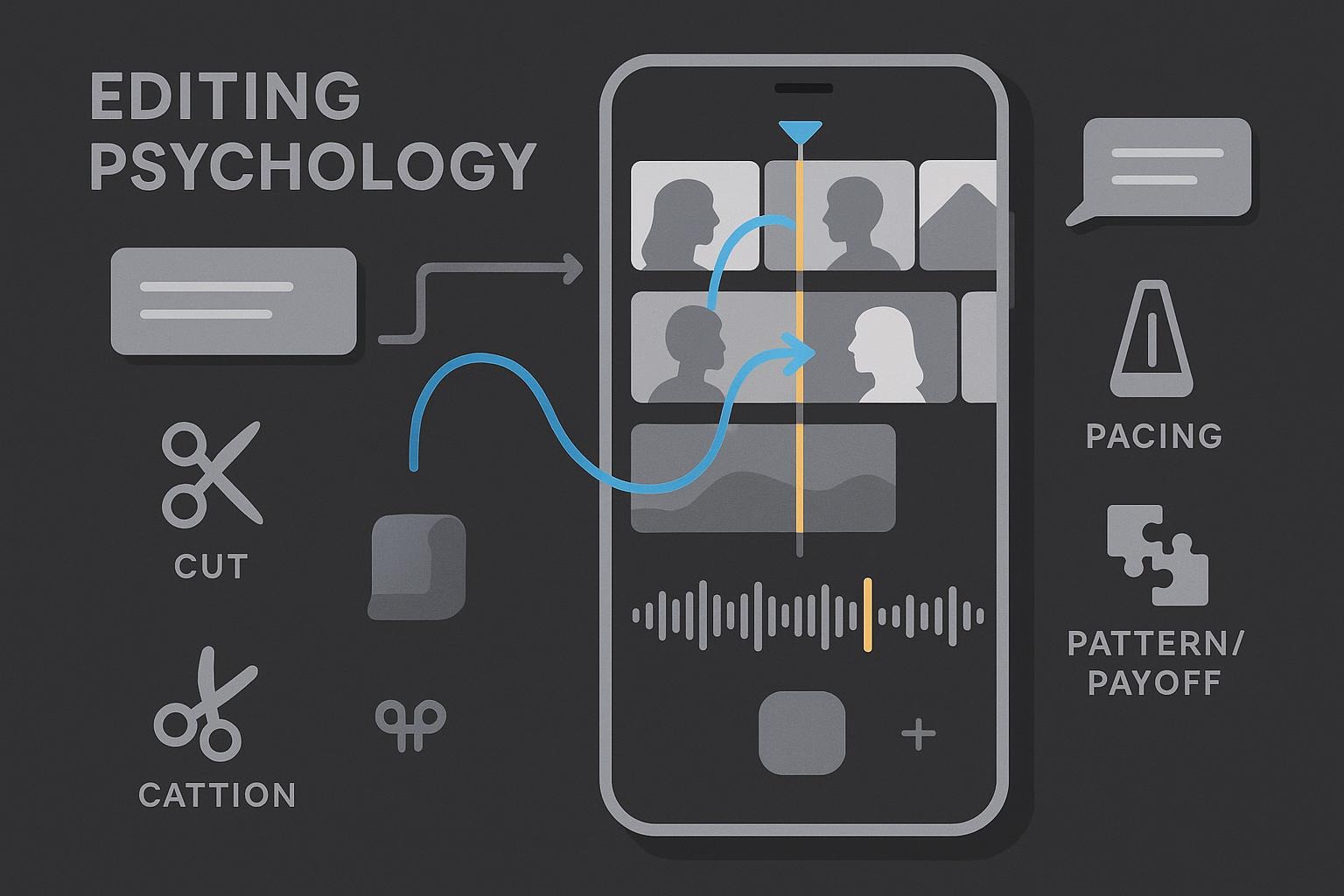
Great editors don't just assemble clips; they engineer attention. This is editing psychology: the art of using behavioral design video techniques to guide what your viewer feels, remembers, and decides.
Every cut is a choice. Every transition sends a signal. And in a world where you have 3 seconds to hook an audience on TikTok or Reels, understanding the psychology of pacing isn't just "theory" it's survival.
Ready to stop editing by gut feeling and start editing for the brain? Let’s dive into the cognitive triggers that actually work.
The Hook: Winning the "Novelty vs. Relevance" Battle
Your viewer's brain is a pattern-recognition machine. It ignores the familiar and filters out the confusing. To win the first 5 seconds, you need to trigger one of two things: Novelty (surprise) or Relevance (value).
The "Reverse Chronology" Trick
Don't save the best for last. The brain craves closure. Show the result first.
Example: Instead of a 30-second build-up of a messy room being cleaned, start with the sparkling clean room for 1 second. Then, rip back to the mess with a "How we got here" graphic. This opens a "cognitive loop" the brain wants to close.
Pacing & Rhythm: It’s Not Just About Speed
Fast cuts are popular, but relentless speed is exhausting. Psychology of pacing tells us that the brain needs "breathing room" to process information. If you overload the viewer, they disengage.
The "Pulse and Pause" Technique
Think of your edit like a heartbeat.
Action: Use 3-4 fast cuts (0.5s - 1s) to build energy.
Rest: Follow with one longer, stable shot (3s - 4s) to let the information land.
Real-World Application: A cooking video might show fast chops of onions, garlic, and peppers (fast), then hold on the sizzling pan as the ingredients hit the oil (slow/satisfying).
Cognitive Load: Don’t Burn Out Their Brain
Here is the golden rule of editing for attention: One clear signal at a time.
A 2025 meta-analysis in Brain Sciences confirms that splitting attention (e.g., reading complex text while listening to fast narration) kills comprehension.
The "Relay Race" Edit
Hand off the baton of attention smoothly.
Bad: Talking head + loud music + busy B-roll + pop-up text all at once.
Good:
Voice: "Here's the secret ingredient..." (No text).
Visual: Cut to close-up of the ingredient.
Text: Pop up the name of the ingredient after the visual is established.
The Eye-Trace: Designing for Flow
Your viewer's eyes are physically moving across the screen. If Cut A has the subject on the far left, and Cut B has the subject on the far right, the brain has to work to find it. This micro-delay causes friction.
The "Center-Mass" Strategy
Keep the focal point in the same quadrant of the screen across cuts.
Example: If you're cutting from a wide shot of a dancer to a close-up, make sure their face is in the exact same screen position. This makes the edit feel "invisible" and keeps the viewer in a flow state, a concept backed by continuity research in Frontiers in Neuroscience.
Emotion Through Juxtaposition (The Kuleshov Effect)
This is the oldest trick in the book, and it still works. The meaning of a shot is defined by what comes before and after it.
Shot A: A man smiles.
Shot B: A baby playing.
Result: The man looks like a loving father.
Shot B (Alternate): A bikini-clad woman.
Result: The man looks creepy.
Modern Application: Be careful with implication. As noted in PLOS ONE (2024), emotional context shifts perception instantly. Use this to guide the viewer's mood, but never to deceive.
How AI Can Be Your "Cognitive Editor"
Understanding these principles is one thing. executing them on a tight deadline is another. This is where AI steps in as your creative partner, not your replacement.
The NemoVideo AI video editor is built with these psychological triggers in mind.
Smart Pacing: It analyzes your footage to suggest cuts that match the natural rhythm of speech and action.
Eye-Trace Analysis: It can auto-crop vertical videos to keep the subject centered, reducing cognitive load.
Hook Optimization: It identifies the most visually stimulating moments to place right at the start.
Your "Psychology-First" Editing Checklist
Before you export, ask yourself these 3 questions:
Where are my eyes? Do they have to jump around too much between cuts?
What is the "One Thing"? Is every second focused on a single visual or auditory message?
Did I earn the attention? Did I open with a hook that creates immediate value or curiosity?
Stop editing for "cool." Start editing for connection.
Try NemoVideo for free today and see how AI can help you master the psychology of the cut.