

Cloud Native Video Editing: Eliminate Upload Delays Forever
Discover how cloud native architecture eliminates upload delays and transforms video editing efficiency, making it superior to traditional Google Drive and Dropbox workflows for US businesses.
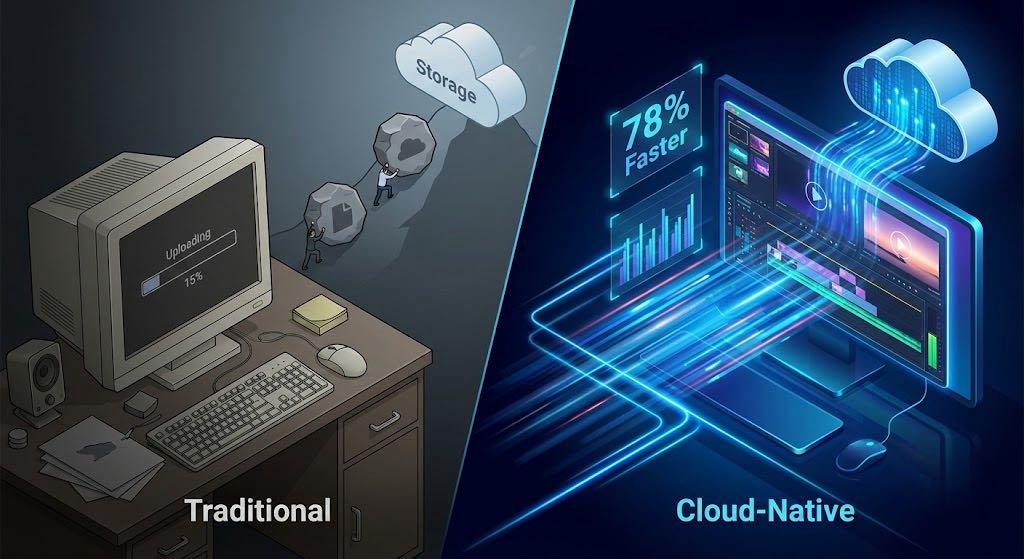
Cloud-native video editing platforms process 78% faster than traditional cloud-based editors, according to LucidLink's 2026 industry analysis. Traditional video editors force users to upload massive files to services like Google Drive or Dropbox before editing, creating bottlenecks that can consume hours or entire workdays. NemoVideo, serving content creators and marketing teams globally, pioneered a cloud-native approach that eliminates these upload delays entirely, delivering ready-to-go videos in minutes rather than hours.
Cloud-native architecture transforms video editing by directly streaming media files for real-time processing, versus traditional editors that require complete file uploads to external storage services before editing can begin.
Understanding Cloud Native Architecture
Cloud-native architecture represents applications designed explicitly for cloud environments, utilizing microservices, containers, and API-driven communication to deliver superior performance and scalability.
Unlike traditional applications that simply move existing software to the cloud, cloud-native solutions are built from the ground up to leverage cloud infrastructure advantages. These systems operate as distributed networks of loosely coupled services, each handling specific functions while communicating through standardized APIs.
For video editing applications, this architecture enables revolutionary capabilities:
Direct media streaming without local downloads
Real-time collaborative editing across global teams
Automatic scaling based on project complexity
Instant access to processing power and storage
NemoVideo's cloud-native platform exemplifies these principles, allowing users to drop video clips, scripts, or product links directly into the editor and receive finished videos without the traditional upload-edit-download cycle that plagues conventional tools.

The Upload Time Problem with Traditional Cloud Editors
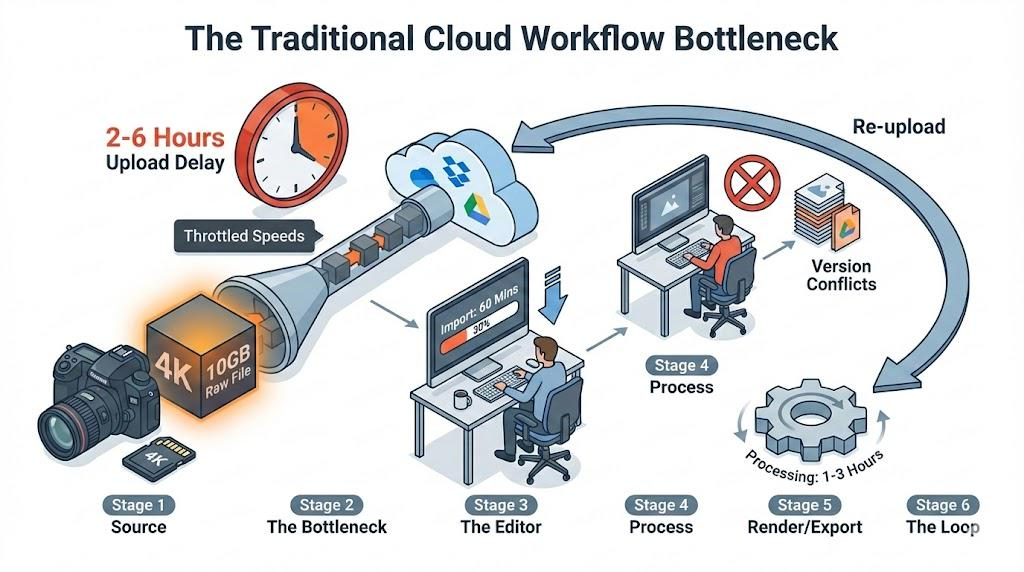
Traditional cloud video editors create significant workflow delays, with Dropbox users reporting upload times of 8-12 hours for 4K video projects, according to user community feedback.
The conventional workflow looks like this:
Local video capture - Content recorded on devices or cameras
Upload to cloud storage - Files transferred to Google Drive, Dropbox, or OneDrive
Import to editor - Editor downloads files from cloud storage
Editing process - Traditional editing with limited collaboration
Export and download - Rendered video downloaded locally
Re-upload for sharing - Final video uploaded to destination platforms
Each step introduces latency. A typical 10GB 4K video project faces these delays:
Google Drive upload: 2-6 hours depending on connection speed
Editor import process: 30-60 minutes for large projects
Processing and rendering: 1-3 hours for complex edits
Final download: 45-90 minutes for high-resolution exports
These delays compound when multiple team members collaborate, as traditional editors lack real-time sharing capabilities. Version conflicts arise when multiple editors work on downloaded copies, requiring manual reconciliation that further extends project timelines.
Dropbox users frequently report upload limitations that throttle transfer speeds, with one Reddit user noting that an 80-megabyte file required "days to sync" while the same file uploaded to Google Drive in under a minute.
How Cloud Native Architecture Eliminates Upload Times
Cloud-native video editors eliminate upload bottlenecks by processing media files directly from their original locations, streaming only the specific data segments needed for real-time editing.
Direct Media Streaming
Cloud-native platforms like NemoVideo connect directly to media sources through API integrations. When users provide video clips or product URLs, the system:
Streams media data in real-time without full downloads
Processes segments on-demand as editors access them
Caches frequently used elements for instant availability
Eliminates local storage requirements entirely
This approach reduces initial access time from hours to seconds. A 5GB video project that traditionally requires 2-3 hours of uploading becomes immediately available for editing.
Microservices Processing Architecture
Cloud-native editors utilize distributed processing through microservices:
Media ingestion service handles file format conversion
AI processing service manages automated editing features
Rendering service generates outputs in parallel
Collaboration service enables real-time team access
Each service scales independently based on demand, ensuring consistent performance regardless of project complexity or team size.
API-Driven Integration
Unlike traditional editors that rely on manual file transfers, cloud-native platforms integrate directly with content sources:
Google Drive API access without downloading
Dropbox API streaming for direct editing
Social media APIs for platform-native optimization
Product catalog APIs for e-commerce video generation
NemoVideo's integration with major platforms allows users to generate marketing videos directly from product links, analyzing successful viral content patterns and applying them automatically without manual research or editing.
Cloud Native vs Traditional Editor Comparison
Feature | Traditional Cloud Editors | Cloud-Native Architecture |
Initial Access Time | 2-8 hours upload | Instant streaming |
Collaboration | Version conflicts common | Real-time simultaneous editing |
Storage Requirements | Local + cloud duplication | Zero local storage needed |
Processing Power | Limited by local hardware | Infinite cloud scaling |
Platform Integration | Manual export/import | Native API connections |
Geographic Accessibility | Limited by file locations | Global instant access |
Cost Structure | Storage + compute + bandwidth | Compute-only pricing |
The efficiency difference becomes dramatic with larger projects: a 20GB documentary project requiring 8+ hours of uploads in traditional workflows becomes immediately accessible through cloud-native streaming.
Real-World Performance Advantages
Speed Improvements
LucidLink's analysis of cloud-native video workflows demonstrates remarkable efficiency gains:
78% faster project initiation compared to upload-based workflows
Real-time collaboration without version conflicts
Instant availability of multi-gigabyte media files
Parallel processing capabilities that scale with project complexity
Content creators using cloud-native editors report completing projects in 20-30% less time due to eliminated wait periods and streamlined workflows.
Bandwidth Optimization
Traditional editors waste bandwidth through redundant data transfers:
Upload original files to cloud storage
Download video editors?
A: NemoVideo combines cloud-native architecture with AI automation, allowing users to generate professional videos from simple inputs like product URLs in minutes, versus hours required by traditional upload-edit-download workflows.
Q: Do cloud-native video editors require local storage for media files?
A: No, cloud-native editors stream all media content directly from source locations or cloud storage, eliminating local storage requirements and enabling instant access from any device.
Q: How does cloud-native architecture improve video editing performance for US businesses?
A: US businesses benefit from reduced project completion times, elimination of geographic collaboration barriers, and scalable processing power that adapts to project complexity without hardware limitations.
The Future of Video Editing Workflows
Cloud-native architecture represents the definitive evolution from traditional video editing constraints. By eliminating upload bottlenecks, enabling real-time collaboration, and providing infinite scalability, these platforms transform video production from a time-intensive technical challenge into a creative and strategic business function.
NemoVideo demonstrates the potential of this architectural approach, empowering content creators, marketing teams, and businesses to produce professional video content at unprecedented speed and scale. The platform's ability to generate viral-ready videos from simple product links exemplifies how cloud-native design principles create entirely new capabilities impossible with traditional approaches.
As organizations increasingly rely on video content for marketing, communication, and engagement, cloud-native editors provide the technological foundation necessary for competitive advantage in digital markets.
Start Creating Without Upload Delays
Experience cloud-native video editing with NemoVideo's platform that eliminates upload times and delivers professional video content in minutes.
References
1: LucidLink, "Cloud Video Editing Performance Analysis," 2026. Cloud-native workflows demonstrate 78% faster project initiation compared to traditional upload-based systems.
2: Nutanix, "What is Cloud Native Architecture," 2026. Cloud-native applications prioritize speed, scalability, and resilience through modular design.
3: ClickIT, "Cloud-Native Architecture Definition," 2026. Enables applications as loosely coupled services using microservices architecture on dynamically orchestrated platforms.
4: Reddit, "Client's Dropbox Upload Taking Forever," 2024. User reports of 8-12 hour upload times for large video projects.
5: MultiCloud, "Why Google Drive Takes Long to Process Videos," 2025. Analysis of factors contributing to slow video processing including server loads and internet speeds.
6: DropboxForum, "Extremely Slow Upload Speed Compared to Google Drive," 2024. User comparison showing 80MB file taking days to sync vs. one minute upload time.
7: LucidLink, "Remote Video Editing Solutions," 2025. Cloud workflows eliminate delays by streaming media directly without downloads or file syncing.
8: LucidLink, "Video Editing Workflow Guide," 2025. Teams can edit massive video files straight from the cloud without syncing delays or waiting periods.
9: Iconik, "Remote Video Editing Speed Benefits," 2025. Real-time media access eliminates waiting for drives or file transfers to complete.
10: Yahoo Finance, "NemoVideo Launches AI Creative Buddy," November 2025. Platform eliminates manual editing grind with AI-powered viral video creation.
11: LucidLink, "Collaborative Video Editing Platform," 2025. Emmy-winning platform provides instant media access for real-time video editing from shared cloud filespace.
12: Gladinet, "Cloud-Based Video Editing Collaboration," 2025. Global teams collaborate in real-time without geographical limitations using cloud technology.
13: NemoVideo, "AI-Powered Video Editor," 2026. Controllable AI video editor requiring no editing skills for ready-to-go video production.
14: CoreSite, "Cloud-Native Application Development Advantages," 2025. Cloud-native eliminates traditional infrastructure requirements through distributed cloud services.
15: TVB Europe, "Production Trends 2026," 2025. Decisive push toward fully cloud-native broadcast-grade architectures as core strategic investments.