
Get Unprecedented Control Over Your Brand Videos with AI
If you’re a real estate agent, fitness coach, or any business owner using video to connect with US customers, you know the struggle: a confused brand voice across different markets, wasted time on repetitive edits, and product videos that just don't convert to sales. You’re not alone in the '300 views jail'.
The solution isn't to work harder; it's to work smarter with AI video editing control. This tutorial shows you a practical, AI-enabled way to fix cross-market inconsistency in three steps—without losing your unique voice or slowing your team down.
This new workflow is all about giving you creative freedom back. It’s an enhanced features approach that shifts you from complex software manuals to a streamlined, 'human-in-the-loop' editing process. It's time for a major upgrade—it. It's time to start revolutionizing video content creation.
Low Video Views & No Sales: The workflow ensures consistency, making your brand recognizable and trustworthy, which drives better performance.
Long Editing Time: The AI handles the "dirty work" (repetitive tasks), freeing you up for creative decisions.
Loss of Control: Unlike other overly automated tools, this process keeps your unique brand identity and creative input at the center.

Step 1: Lock in Your Brand's Rules (Make Consistency Easy)
Consistency is the single biggest driver of a high-converting video strategy. If your brand looks and sounds different in every market, you're paying an invisible tax. This step is about centralizing your brand’s personality so your AI buddy can follow the rules every time.
What you’ll produce in this step:
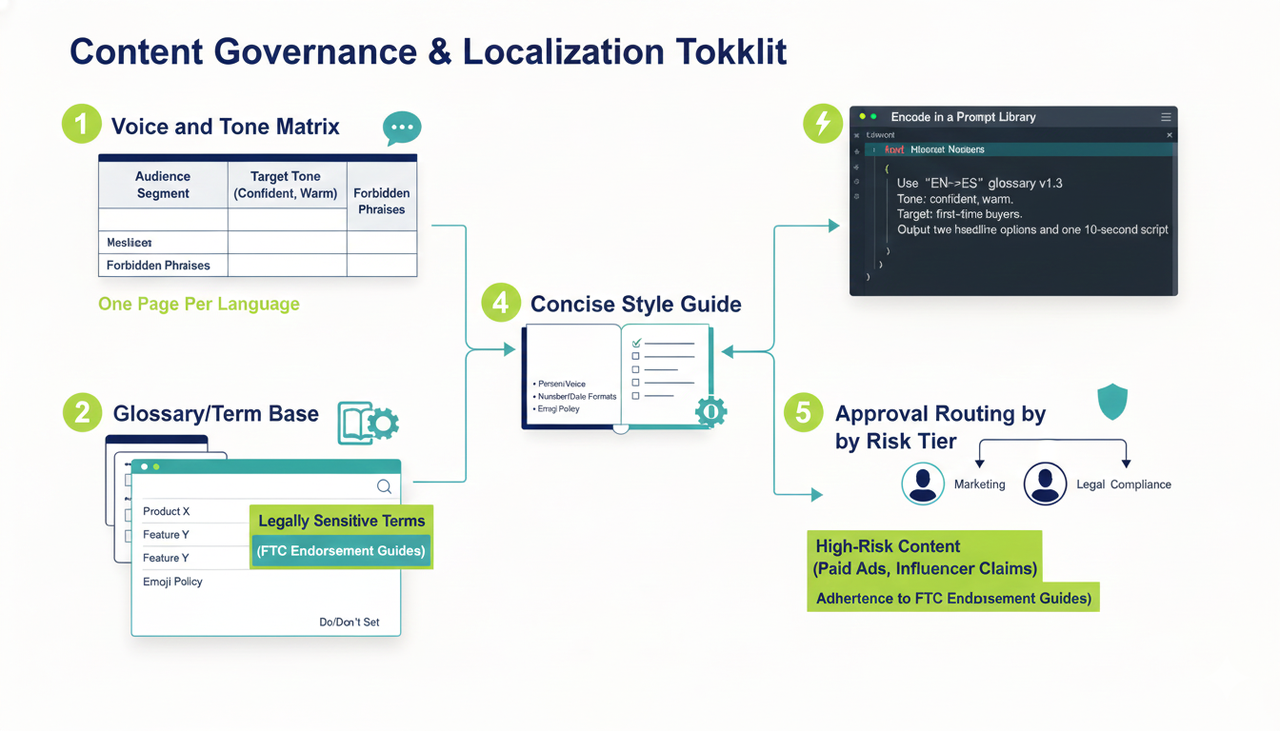
A voice and tone matrix by market.
A concise style guide with "do/don't" examples.
A term glossary/term base (with approved translations).
A prompt library that encodes your brand rules.
Why this matters: Centralized, living guidelines and templates are the biggest driver of consistency. Industry guidance emphasizes publishing accessible guidelines, using approved assets, and automating reviews and approvals; see the governance themes outlined by Frontify’s AI for Brand Management guide (2024–2025).
How to do it (lightweight but effective):
Create a Voice and Tone Matrix: Columns should include market/language, audience, tone (e.g., confident, warm), and forbidden phrases. Keep it to one page per language to avoid bloat.
Establish a Glossary/Term Base: Include product names, features, and sensitive words. For US-based content, always include context on legally sensitive terms.
Draft a Concise Style Guide: Specify person/voice, number/date formats, and your emoji policy. Include a small “do/don’t” set for quick onboarding.
Define Approval Routing by Risk Tier: For US-based marketing, high-risk content (like paid ads with claims or influencer content) requires legal/compliance sign-off to adhere to the latest FTC Endorsement Guides: What People are Asking
Encode it in a Prompt Library: Write reusable prompts that reference your style guide. Example: “Use the ‘EN→ES’ glossary v1.3. Tone: confident, warm. Target: first-time buyers. Output two headline options and one 10-second script.”
Step 2: AI-Assisted Adaptation at Scale (Beyond Translation)
The goal here is simple: turn one awesome, on-brand master asset into consistent, market-ready variants—fast—while keeping humans in the loop for that crucial final polish.
Decision Tree: Translation vs. Localization vs. Transcreation
Type of Adaptation | When to Use It | Key Focus |
Translation | Precision overrides persuasion (e.g., technical docs). | Word-for-Word Accuracy. |
Localization | Most marketing assets (changing units, legal lines, imagery). | Cultural Fit & Local Rules. |
Transcreation | High-emotion creative (taglines, slogans, flagship ads). | Preserving Emotional Intent. |
Why the hybrid approach works: Many teams combine AI generation with human post-editing. This “AI first pass, human polish” model is widely recommended in 2024–2025 guidance such as Transifex’s AI localization overview (2024) and Lokalise’s guidance on concise style guides and context (2024).
How to get the best results:
Prepare the Master Asset: Separate copy from visuals. For video, note target durations per platform (like TikTok), on-screen text, and any “must keep” visual moments.
Feed AI with Context, Not Just Text: Provide the market’s tone matrix, style guide, and allowed brand claims.
Run Human-in-the-Loop (HITL) Edits: In-country reviewers adjust nuance, references, and pacing. In the US, reviewers are key to ensuring legal compliance.
Practical Example: Multi-Market Video Versioning with an AI Editor
You can use Nemo (AI Video Editor) to template your story structure, auto-select strong footage, and generate multiple variants for different markets and aspect ratios (like 9:16 for a TikTok Ad).
The template anchors structure, timing, and typography; the glossary and style guide anchor language; and the bulk generation enforces uniformity while allowing local nuance.
🧠 How NemoVideo's AI Gives You Creative Freedom (The Methodology)
NemoVideo operates on a simple premise: your creativity comes first. It's not a black box that takes away your unprecedented control. It’s a specialized AI workflow built for content creators who need professional results without the Adobe learning curve or the overly UGC style of tools like CapCut.
This is the technical process simplified:
The Conversational Core: Instead of a complex timeline, you talk to your video. You can say, "Make the hook faster and change the music to something from the Commercial Music Library." The AI translates your intent into an edit.
Intelligent Rough Cut: The system automatically ingests your footage and cuts a "dirty work" rough draft based on the most engaging moments, saving you hours of splicing.
Template Enforcement: It uses your brand’s logo, colors, and subtitle style (from Step 1) as an unshakeable foundation, guaranteeing that all generated variants are structurally consistent and ready for platforms like TikTok.
Bulk Localization: The AI can generate market variants in bulk, swapping out on-screen text and subtitles for localized versions, making it perfect for scaling TikTok Auction In-Feed Ads and ensuring your Accessibility for watching videos standards are met globally.

Step 3: Measurement and QA (Close the Loop)
The final step is to ensure your assets are not only consistent but are also performing.
Global Authority Citation: The global AI video market is projected to grow significantly, proving that investing in tools that offer AI video editing control is a future-proof strategy.
Pre-flight QA Checklist (Run before publishing):
Terminology: Matches glossary; no forbidden terms.
Visuals: Logo placement, typography, and color usage follow the brand kit.
Legal/Locale: Localized disclaimers/units/claims correct (especially important for US legal compliance).
Accessibility: Subtitles are present, readable, and properly timed (critical for Creative best practices and accessibility).
Performance Metrics to Track (Crucial for US Digital Marketing):
Brand compliance rate (assets passing pre-flight without rework).
Engagement rate and conversion rate by market.
Review costs per asset (to spot bottlenecks).
Use these metrics to inform your Split test best practices.
Frequently Asked Questions (FAQ)
Q: Why is a single, consistent brand voice so important for video sales?
A: In the US market, consumers trust brands that are easily recognizable and predictable across platforms. If your video ads or product demos look different every time, it confuses the viewer, weakens your brand equity, and ultimately hurts your conversion rate. Consistency builds trust, and trust drives sales.
Q: How is this "AI video editing control" different from other automated tools?
A: Many tools are too automated, leaving no space for your creativity—they. They take control of you. NemoVideo is an "AI Creative Buddy". It handles the repetitive "dirty work" (like splicing, resizing, and adherence to style rules) while you remain the creative director, guiding the process through simple, conversational commands.
Q: Do I still need human reviewers if the AI is handling the localization?
A: Yes, absolutely! We advocate a "human-in-the-loop" approach. The AI gives you a perfect first draft, but a human reviewer is essential for nuance, cultural references, and most importantly, legal compliance for claims and Promoting a brand, product, or service in the US.
🌟 Comparison Table: Traditional vs. AI-Powered Workflow
Feature | Traditional Editing Workflow | NemoVideo AI-Powered Workflow |
Consistency | High risk of 'brand drift' across markets/editors. | Enforced by brand templates and glossary (locked structure). |
Time to Market | Weeks (due to manual editing and QA checks). | Hours (AI bulk generation and automated checks). |
Required Skill | Professional editing skills (Adobe Premiere Pro). | Conversational language—no complex skills required. |
Creative Control | Full, but time-consuming. | Unprecedented control over strategy, not just clicks. |
Compliance | Manual check by legal team. | AI red-teams for risk, flagging issues for legal review. |
🎉 Ready to Stop Editing and Start Creating?
This new workflow, powered by AI video editing control, is your path out of the "editing time sink." By putting governance in place and letting your AI Creative Buddy handle the repetition, you gain creative freedom and the certainty that your videos are consistent, compliant, and optimized for conversion.
Stop struggling with inspirations, jumping between ChatGPT for scripts, CapCut for editing, and TikTok for ideas. This is your all-in-one, enhanced features tool for revolutionizing video content creation.
Your Next Step: Ready to stop editing and start creating? Give NemoVideo a try.