
AIDA Video vs. PAS vs. Hero’s Journey: The Marketer’s Plain-English Guide
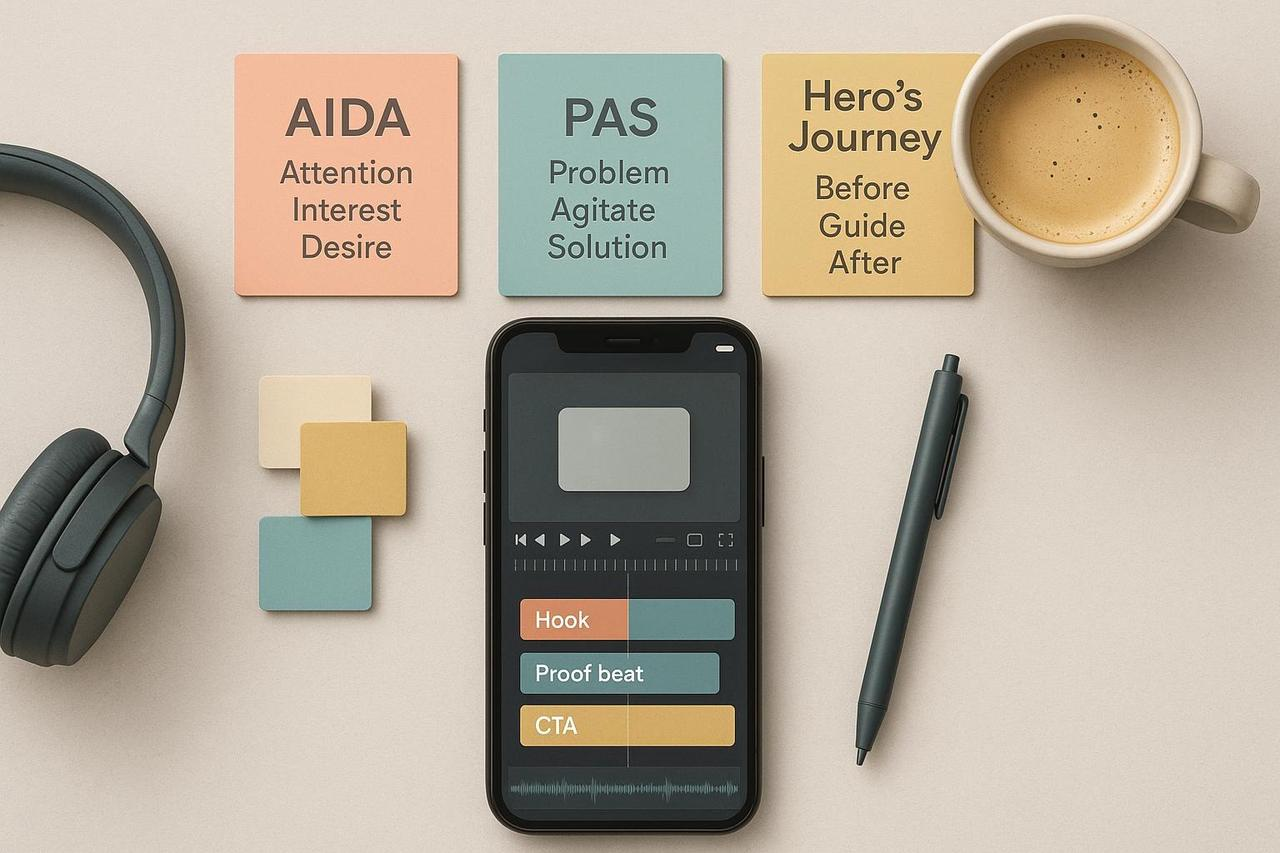
Stop staring at a blank timeline.
If you are churning out short video ads or social content, you do not need to be a creative genius every single day. You just need a safety net. Frameworks turn the panic of "What should I say next?" into a repeatable plan that you can script, edit, and test at scale.
This guide breaks down the big three: AIDA, PAS, and the Hero’s Journey. We will strip away the theory and show you exactly how to translate each one into 15 to 45 second videos with practical editing cues.
What Each Framework Actually Means
Let's cut the jargon. Here is the one-sentence definition for each.
AIDA: A persuasion sequence that guides a viewer from Attention to Interest, Desire, and finally Action. It is the gold standard for structuring ads and landing pages, as summarized in HubSpot's 2025 AIDA model overview.
PAS: A punchy arc that names a Problem, briefly Agitates the stakes to make it real, then presents a Solution with a clear CTA. You can see a deep dive in Crazy Egg's 2024 guide to the PAS framework.
The Hero’s Journey: A classic narrative arc that moves a character from a "before" state to a transformation. In marketing, this means treating the customer as the hero and the brand as the guide, a philosophy popularized by the StoryBrand customer-as-hero approach.
What they are not:
AIDA and PAS are not character-driven stories. They are persuasion sequences.
The Hero’s Journey is not a conversion formula. It is a storytelling arc best used for brand films and case studies.
When to Use Which Framework
Don't guess. Use this decision matrix.
Use AIDA when: Your goal is direct response. This fits aida video ads, product demos, and any placement where a clear CTA is the priority.
Use PAS when: Your audience feels a specific pain (or needs help recognizing it). This is perfect for UGC-style clips and problem/solution ads.
Use Hero’s Journey when: You need emotional resonance. Think founder stories, customer transformations, or brand films.
The Hybrid Reality:
Most modern journeys are nonlinear. While AIDA is a linear funnel, many marketers pair it with ongoing engagement models. For a broader view, look at Smart Insights' overview of integrating the RACE framework (Reach, Act, Convert, Engage).
Turn Frameworks into Short Video Scripts
Here are practitioner-ready micro-scripts. We have adapted the timing for TikTok, Reels, and Shorts.
The AIDA Video Script (20–30 Seconds)
Best for: DTC Products and Direct Response.
Script Outline:
0–3s (Attention): Use a thumb-stopping visual or pattern interrupt.
Text: "What if your [task] took 60 seconds?"
3–10s (Interest): Quick benefit tease mixed with relevant B-roll.
Audio: "No more [annoyance]. Just tap, done."
10–23s (Desire): One major proof beat. This could be a fast demo, a before/after clip, or a social proof overlay (e.g., "2,100+ reviews").
23–30s (Action): Clear CTA with an end card.
Audio: "Try it today."
Editing Cues:
Open Hot: Bright first frame, motion in the first 0.5 seconds, and a bold caption under 8 words.
Maintain Pace: Keep a 1.2–1.5x rhythm. Use micro-zooms on benefits and change the visual beat every 2–3 seconds.
Proof Matters: Show the product solving something in real time.
Safe Zones: Ensure your CTA at the 23-second mark isn't covered by the platform UI.
The PAS Video Script (15–20 Seconds)
Best for: UGC Demos and Pain-Point Awareness.
Script Outline:
0–4s (Problem): Close-up of a relatable pain.
Audio: "Ever spend 10 minutes doing [X]?"
4–10s (Agitate): Two quick consequences via jump cuts.
Audio: "Late again. Mess everywhere."
10–18s (Solution): Quick reveal and demo.
Audio: "I switched to [product]. One tap, done."
Text: "Get yours."
Editing Cues:
Keep it Human: Use selfie framing, natural lighting, and a real environment.
Empathy over Fear: Agitate with truthful annoyances, not scare tactics.
Jump Cuts: Accelerate the cuts during the "Agitate" phase, then slow down once the "Solution" appears.
The Mini Hero’s Journey (30–45 Seconds)
Best for: Customer Stories and Case Studies.
Script Outline:
0–6s (Before): Quick snapshot of life with the problem (The Ordinary World).
Audio: "I dreaded [task] every day."
6–16s (Call & Guide): Introduction of the solution.
Audio: "A friend showed me [brand]. They said, 'Do these two steps.'"
16–30s (Trials/Success): Short attempt montage leading to a small win.
30–40s (After): Transformation payoff (Return with Elixir).
Audio: "Now I’m done in 5 minutes."
40–45s (CTA): "Want the same? Here’s how to start."
Editing Cues:
Visual Arc: Use cooler colors/tempo in the "before" section, switching to warmer and steadier shots in the "after."
Brand Role: The brand is the guide, not the hero. Prioritize the customer's transformation.
How to Scale Versions Without Burnout
You do not need a brand-new script for every single upload. That is the fast track to burnout.
Instead, create one baseline script per framework. Then, generate variants by swapping:
Hooks: Change the visual and the first spoken line.
Proof Beats: Swap a demo angle for a testimonial snippet.
CTAs: Test a different offer or destination.
The AI Workflow:
You can streamline this process with an AI editor. Tools like NemoVideo can auto-detect the strongest shots in your footage, keep the pacing tight, and help you produce multiple versions quickly.
Example Workflow:
Draft: Write one aida video script with three different hook lines.
Select: Let the NemoVideo AI video editor tool surface the best visuals to match each hook.
Version: Generate 4–6 cuts varying the proof beat (demo vs. social proof).
Test: Deploy across placements and compare the 3-second hold rate.
Common Mistakes and Quick Fixes
AIDA Mistake: Treating every step as equal length.
Fix: Shorten the Interest phase. Expand the strongest proof moment in the Desire phase.
PAS Mistake: Over-agitating to the point of manipulation.
Fix: Keep agitation to two quick, truthful consequences. Lead with empathy.
Hero’s Journey Mistake: Making the brand the hero.
Fix: Cast the customer as the hero. The brand provides the plan.
Accessibility Miss: Hard-to-read captions.
Fix: Use high contrast, large fonts, and respect safe zones.
Blending Frameworks
Real creativity happens when you mix and match.
PAS into AIDA: Open with Problem/Agitate for a fast emotional hook, then pivot to AIDA's Desire (proof) and Action.
Hero inside AIDA: Use Attention/Interest to set the "before" state, show Desire as the transformation, and end with Action.
How to Measure Success
AIDA: Track 3-second hold rate, mid-point retention, and end-card CTR.
PAS: Monitor drop-off between Problem and Solution. Look for comments mentioning "I feel this."
Hero’s Journey: Watch completion rate and qualitative sentiment about the transformation.
Final Thoughts
Frameworks are scaffolding, not handcuffs. Start with one, keep your pacing tight, and show real proof fast.
If you are ready to test more variants with less manual effort, sign up for NemoVideo today. Speed up your versioning, master your pacing, and stop guessing what works.